
Arrest Warrants in Lee County
Georgia law treats an arrest warrant as a judge's order to take someone into custody. Lee County Magistrate Court lists this work openly. It issues arrest and search warrants and runs warrant-application hearings, first appearances, bond hearings, and preliminary hearings. The judge reads the sworn material first. Only then is the legal standard applied. A filed application alone does not mean a warrant exists. After issuance, service falls to law enforcement. The Lee County Sheriff's Office, Georgia State Patrol, Leesburg Police, or Smithville Police may serve it, depending on jurisdiction and the investigation. The court keeps control of the order and every step that follows.
Lee County Warrant Application Review
A warrant application in Lee County starts with Lee County Magistrate Court. The court lists arrest and search warrant issuance, bond hearings, and preliminary hearings among its duties. Call (229) 759-6016 or (229) 759-6031 to confirm jurisdiction and filing procedure. That page lists its warrant role and contacts.
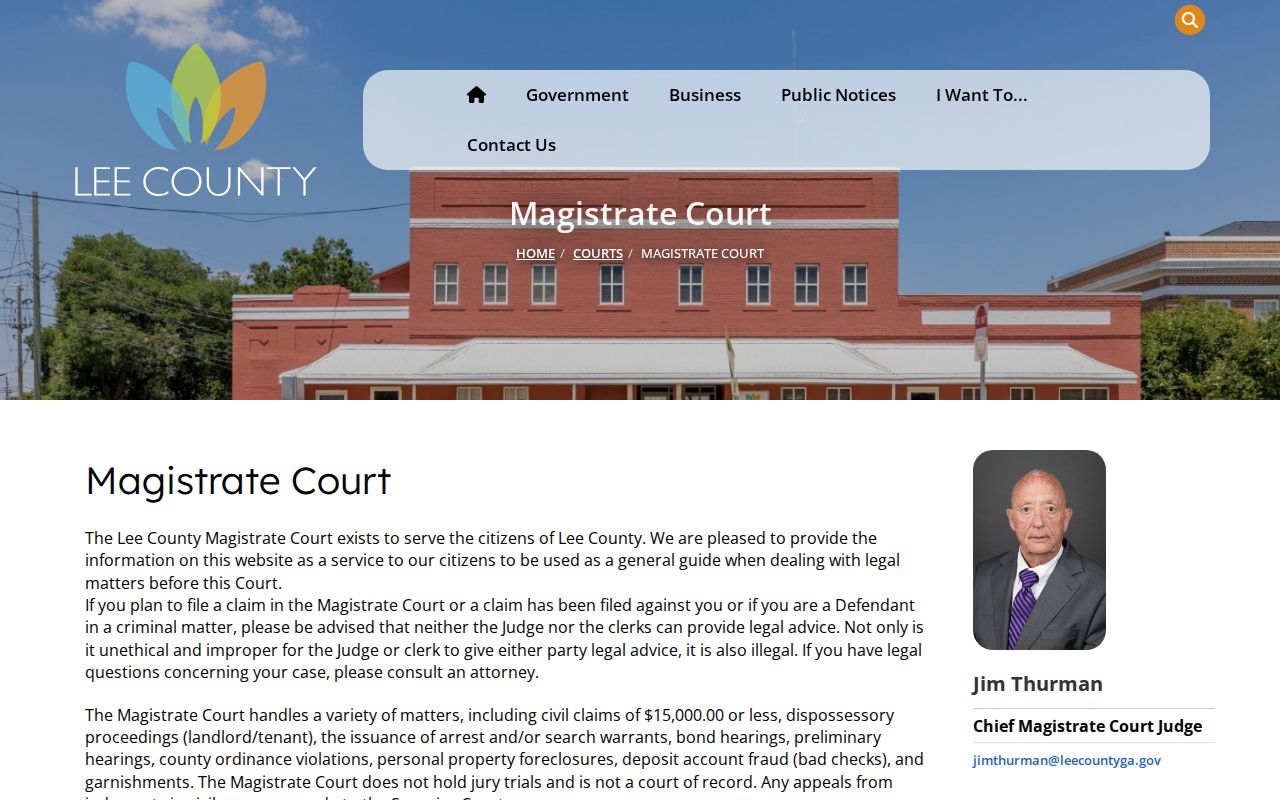
The page confirms the court's judicial duties and nothing more. It offers no public warrant search, no set bond amount, and no guaranteed outcome from an application.
Key point: An application asks for judicial review; only judicial action creates a Lee County arrest warrant.
What a Lee County Arrest Warrant Contains
Lee County publishes no sample arrest warrant. What follows describes typical field groups, not a real record. An actual released warrant may omit or redact fields for privacy, sealing, safety, or an open case.
| Record type | Arrest warrant rather than an application, bench warrant, or search warrant. |
|---|---|
| Case identifier | The court's number, if public. No Lee County sample format was verified. |
| Basis or offense | The stated legal matter, subject to access limits. |
| Issuing court | The judicial office that owns the warrant and later court process. |
| Issue and status dates | When the court acted and the time through which a stated status was current. |
| Bond information | Case-specific terms if set and released; Lee County publishes no universal schedule. |
Lee County Criminal Forms Have Limits
The Magistrate Court criminal forms page posts a Good Behavior Bond warrant application and a Deposit Account Fraud application, printable and returnable by fax, mail, or hand delivery. That route only moves paper. It creates no online warrant result. It also cannot clear an outstanding order. The official page shows the paper-to-court path Lee County uses.
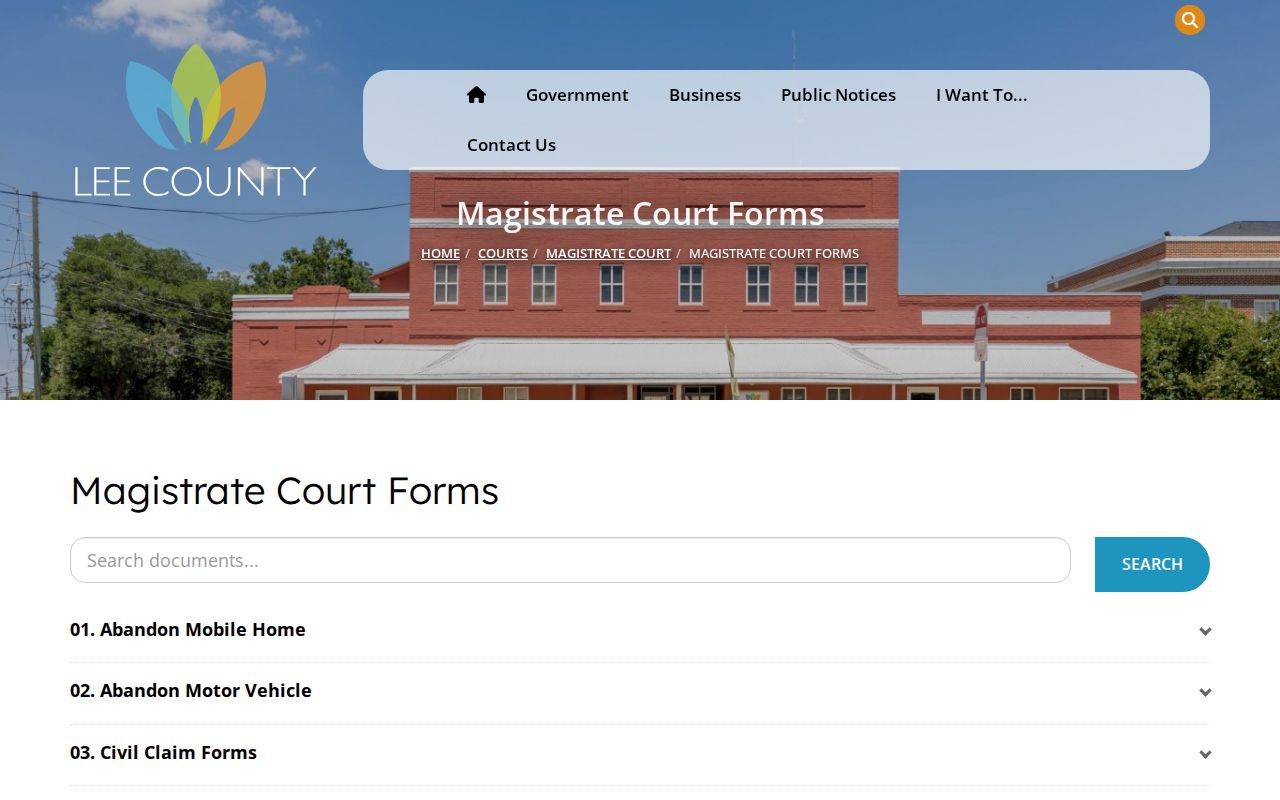
A blank filing form is one thing. An issued Lee County arrest warrant is another. Completed applications can carry birth dates, addresses, phone numbers, ID numbers, relationship details, and a narrative. Send that sensitive material only through the official court route, after confirming instructions.
How Lee County Arrest Warrants Are Served
The Lee County Sheriff's Office handles court orders, court security, and the Criminal Justice Center. Leesburg's city code lets police execute warrants inside city authority. The application form names four investigating agencies. Those are Lee County Sheriff, Georgia State Patrol, Leesburg Police, and Smithville Police. Jurisdiction, in other words, matters here. After service, a person may be booked and moved through first appearance, bond, preliminary, extradition, or committal steps. Magistrate Court publishes those functions. No case follows one fixed timeline. A booking page also cannot prove a warrant still stands after service. For sheriff routing, call non-emergency at (229) 759-6012. The Criminal Justice Center main line is (229) 759-3334.
Arrest Records Are Not Lee County Warrants
Citizen Connect, tied to the sheriff, splits Lee County arrest, confinement, and incident records into separate searches. Its Arrest Search works off dates. Confinement screens show custody, admissions, charges, and arresting agency. Incident Search uses case and location fields. None of those tools carries a warrant-status field. An arrest event may just mean a warrant was served already. A confinement entry reflects custody at that record's moment. An incident can exist with no warrant at all. For the warrant itself, ask the court or sheriff and check the record's timestamp; the Superior Court clerk page states that office maintains criminal warrants and criminal cases.
Note: No result in an arrest or jail screen is not proof that Lee County has no active arrest warrant.
Arrest Warrant vs Summons vs Bench Warrant
The title on the court paper controls what it is. An arrest warrant authorizes custody after a judge reviews probable cause. A summons orders an appearance without arresting anyone. A bench warrant flows from judicial action in a case, often after a missed date. The labels are not interchangeable in Lee County.
| Feature | Arrest Warrant | Summons | Bench Warrant |
|---|---|---|---|
| Core direction | Authorizes arrest | Directs appearance | Authorizes action after a court default |
| Starting basis | Probable-cause material | Notice of a required court date | Missed date or unmet court duty |
| Key office | Issuing court and serving agency | Court named on the summons | Court with the underlying matter |
| Response | Counsel, surrender planning, bond process | Appear as directed | Ask about appearance or recall |
Requesting Lee County Arrest Warrant Records
Pick your records channel by who holds the paper. The Superior Court clerk keeps that court's criminal warrants and case files. For existing sheriff records, the NextRequest portal is the route. Magistrate Court holds its own warrant applications and hearings. City matters go through the municipal clerk. When you write, name the record type, the likely office, the date range, and any case number you have. Ask for a document that exists. No Lee County office will build a custom warrant list for you. Georgia Open Records rules allow redaction, fees, and withholding under exemptions, and sealed, unserved, investigative, or juvenile material may stay closed. One more caution: a records answer can trail behind court action, so if your own status is urgent, get a current confirmation from the court or sheriff and talk to a lawyer.
What to Do If There's a Warrant for You
Confirm the issuing court and the warrant's current status through an official number first. Never walk up to a counter on a third-party result alone. Georgia guidance is blunt: some offices require an in-person visit, and a person who shows up with an active warrant may be taken into custody. A lawyer can arrange voluntary surrender, a first appearance, and possible bond in Lee County. Counsel can also ask whether a motion or court setting could recall the warrant.
- Identify the court and case from official papers or a direct office check.
- Call the court or sheriff and ask about identification, location, timing, and custody procedure.
- Consult a Georgia lawyer before appearing or turning yourself in.
- Follow the issuing court's instructions for surrender, bond, hearing, or judicial review.
- Verify the final court status rather than relying on an old web record.
Lee County publishes no bond schedule, payment shortcut, amnesty day, or walk-in recall process. Posting bond does not dismiss or close the case. The Lee County warrant records overview covers the court and sheriff roles in more depth.
Important: Seek legal advice before surrender; an active Lee County arrest warrant can lead to custody during contact with law enforcement.
Lee County Warrant Payment Scams
South Georgia warnings describe callers who claim an arrest warrant can vanish once you pay. Real law enforcement does not turn warrant service into a phone demand for gift cards, prepaid cards, mobile transfers, or cryptocurrency. A Lee County jury-duty scam warning made the same point and sent residents back to the clerk. Hang up. Then find the number yourself on a government page. The sheriff's non-emergency line is (229) 759-6012, and the Superior Court clerk answers at (229) 759-6018. Do not trust caller ID. Ignore any payment link the caller sends. Lee County has no general arrest-warrant payment portal. A court may give case-specific bond or payment instructions, but never through an unsolicited threat call.