
How to Search for a Warrant in Lee County
Georgia's existing-warrant guidance tells you to contact the local sheriff with the subject's first and last name, date of birth, and county in hand. Lee County Sheriff's Office lists (229) 759-6012 as a non-emergency number and (229) 759-3334 as its main line. Neither is a dedicated warrant line. Use them for official routing, and keep records questions off 911. Call before visiting a counter. The state warns that some offices require an in-person check, and someone who walks in with an active warrant may be taken into custody. A lawyer can weigh that risk and contact the controlling court for you. That call often settles the question safely.
- Identify the court from a ticket, summons, bond paper, or case notice.
- Call the sheriff’s published non-emergency line if the issuing office is unknown.
- Call Magistrate Court for its warrant-application, bond, or preliminary-hearing work, or the Superior Clerk for Superior criminal-warrant records.
- Use Leesburg Municipal Court for a Leesburg traffic or ordinance matter. Confirm a Smithville matter through the city because no detailed court page was found.
- Use NextRequest for a defined sheriff record. No public statewide or countywide warrant portal replaces these calls.
Lee County Warrant Search Has No Portal
Lee County publishes no official warrant-search URL. The sheriff's page links to Citizen Connect, but its public menu covers incident, arrest, accident, daily-report, and confinement functions, with no warrant tab anywhere. A blank result proves nothing either way: a court may still hold the order, access may be restricted, or a status change may not show up in a separate law-enforcement dataset. The official Citizen Connect arrest interface lays out its date-range search format.
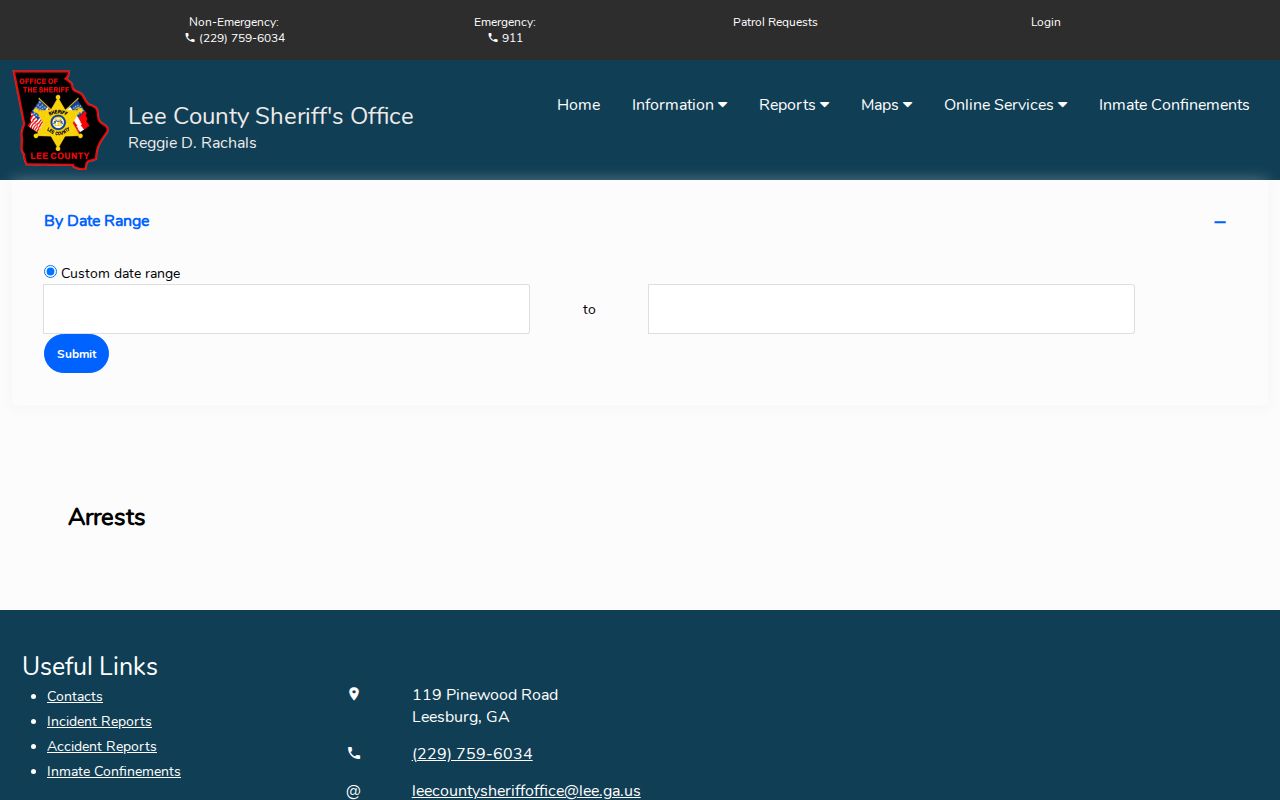
Those fields document arrest events only. They omit the issuing court, current warrant status, any recall date, and any complete list of outstanding Lee County warrants.
Lee County Warrant Search Fields
Lee County has no public warrant form. That means no official online fields exist to fill in. The guidance above shows what a private inquiry needs instead: Georgia's warrant rules and the right local court routing. Give the verified office only what it asks for. A date of birth separates common names well, but it should never be posted in a public request description.
| Field label | Type | Required | Notes |
|---|---|---|---|
| First name | Text | Usually | Use the full legal form when known. |
| Last name | Text | Usually | Ask how aliases or former names are handled. |
| Date of birth | Date | Agency directed | Share privately with the verified sheriff or clerk. |
| County | Place | Yes for state guidance | Specify Lee County, Georgia. |
| Court or case reference | Text | If known | A citation or case number helps route the inquiry. |
Lee County Magistrate Starts Many Warrants
Lee County Magistrate Court is the clearest local channel for arrest and search-warrant applications, bond hearings, and preliminary hearings. Reach it at (229) 759-6016 or (229) 759-6031, or by email at magistrate@leecountyga.gov. The court sits in the Courthouse Annex at 104 A Leslie Highway, Leesburg, GA 31763. Those duties do not mean Magistrate holds every city, Superior, Probate, juvenile, or federal record. The official Magistrate Court page lists its warrant and hearing functions.
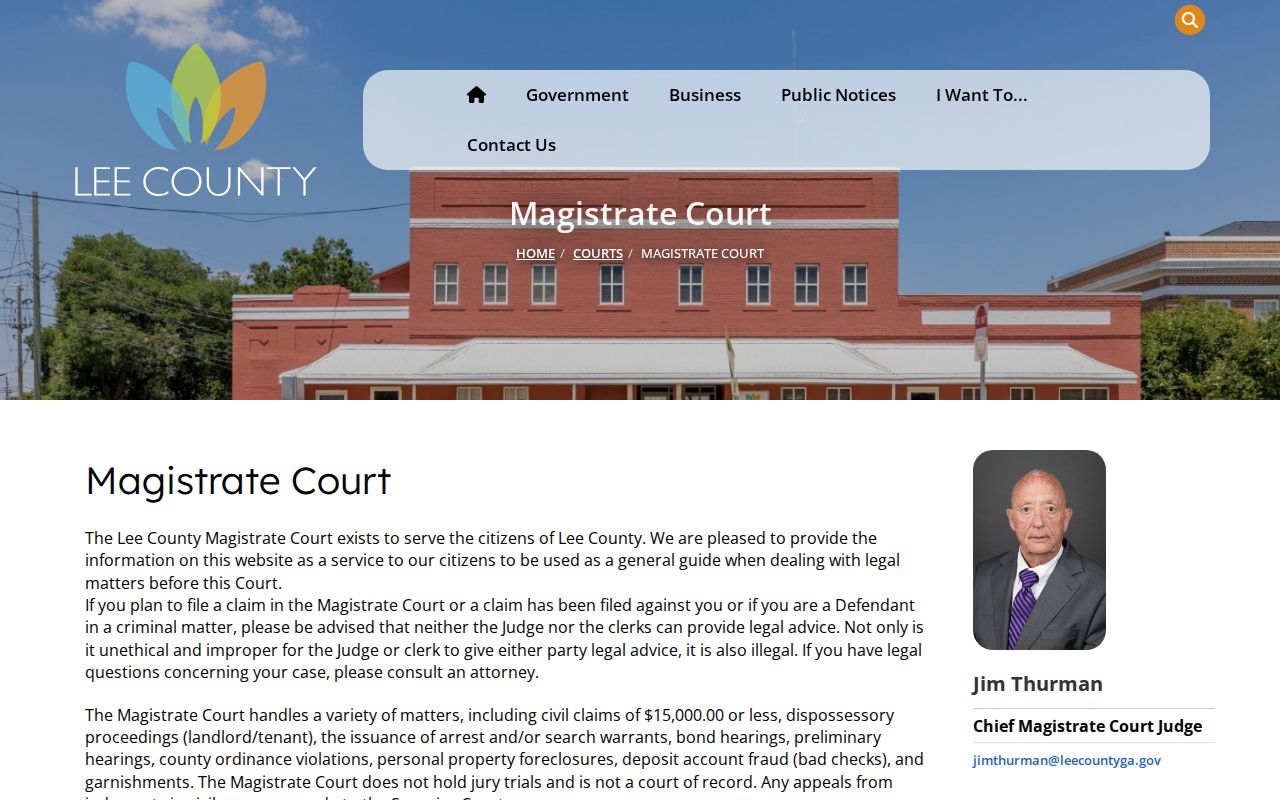
That court page is a routing source, not a live warrant list. Ask Lee County staff which office handles the exact record, and remember that clerks cannot give legal advice.
What a Lee County Warrant Search Returns
A direct confirmation or a released record may include some familiar fields. Lee County publishes no official sample row and no universal identifier format. So no invented sample warrant number should be read as a Lee County code. A complete answer needs the source, the court, and the date of the status check.
| Warrant reference | A court or agency identifier, if released. No local public format was verified. |
|---|---|
| Alleged offense | The accusation tied to the order; it does not establish guilt. |
| Issuing court | The court that controls recall, quash, bond, appearance, or other action. |
| Issue information | The date or case event linked to issuance, when public. |
| Bond terms | Case-specific terms if applicable. No countywide public bond schedule was found. |
| Status as of | The reported state at a stated time, which should be confirmed with the court. |
Lee County Booking Results Do Not Confirm Warrants
Citizen Connect also offers current confinement, admissions, charges, and arresting-agency views. Those screens answer custody questions, nothing more. Someone may be confined on several charges while a served warrant is no longer outstanding. A person with an unserved warrant may not appear in jail data at all. Treat a booking record as an active-warrant result and the meaning of the source flips. The official confinement interface shows its custody-focused tabs and date controls.
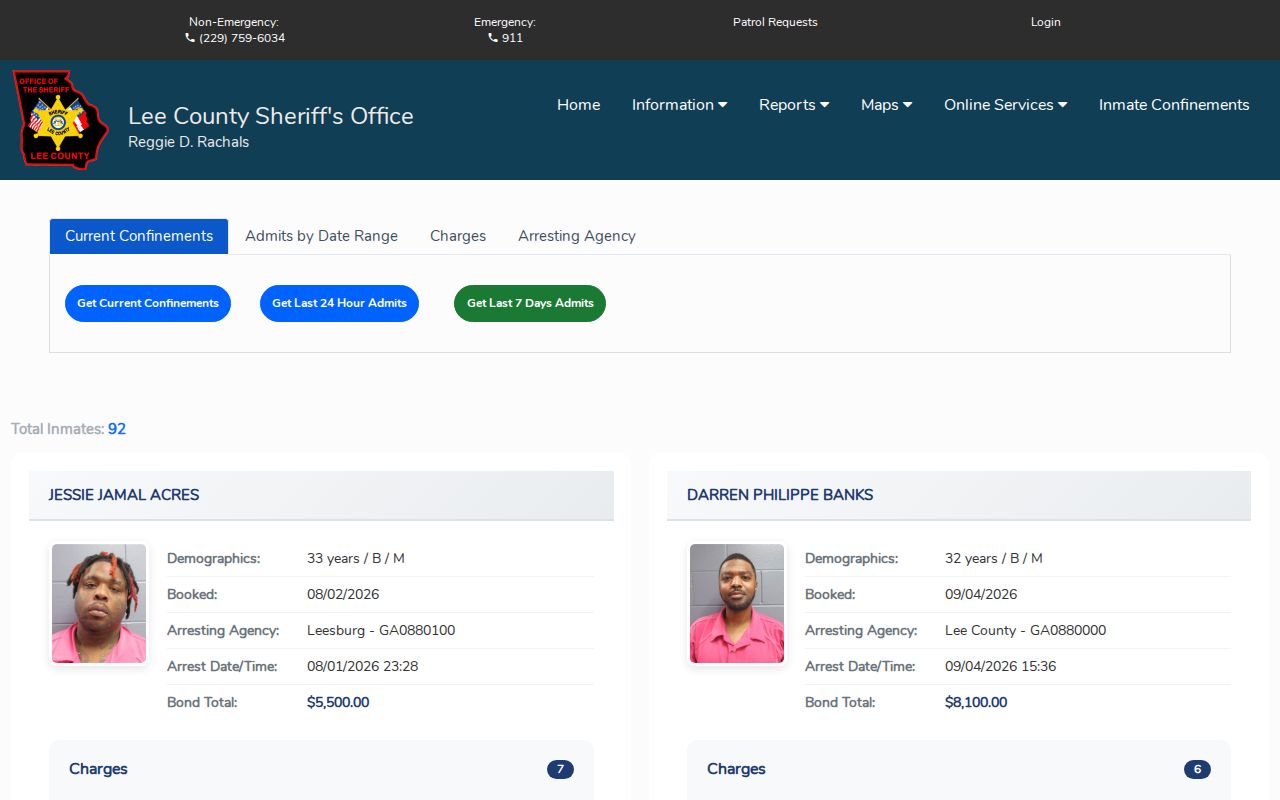
That is the boundary between a jail search and a Lee County warrant search. Confirm any warrant through the issuing court or the sheriff.
Where Lee County Warrants Are Checked
For county law-enforcement direction, start with the Lee County Sheriff's Office. For an application, bond, or preliminary matter, use Magistrate Court. For a Superior Court criminal warrant record, contact Clerk of Superior Court Sara Clark at (229) 759-6018 or sara.clark@gsccca.org, 100 Leslie Highway, Leesburg, GA 31763. The Superior Clerk's official page states that the office maintains criminal cases and criminal warrants. Municipal matters stay with the city court. Leesburg Municipal Court and police use (229) 759-6465 for city traffic and ordinance procedure. Smithville confirms a municipal court but posts no detailed warrant page; its main city line, (229) 903-5537, is the safest published confirmation route. Probate Court at (229) 759-6005 handles published county traffic-fine payment functions, not a universal Lee County criminal-warrant index. Georgia offers no public statewide warrant search and no centralized statewide traffic-citation database. The official incident search shows another public interface that must not be mistaken for a warrant index.
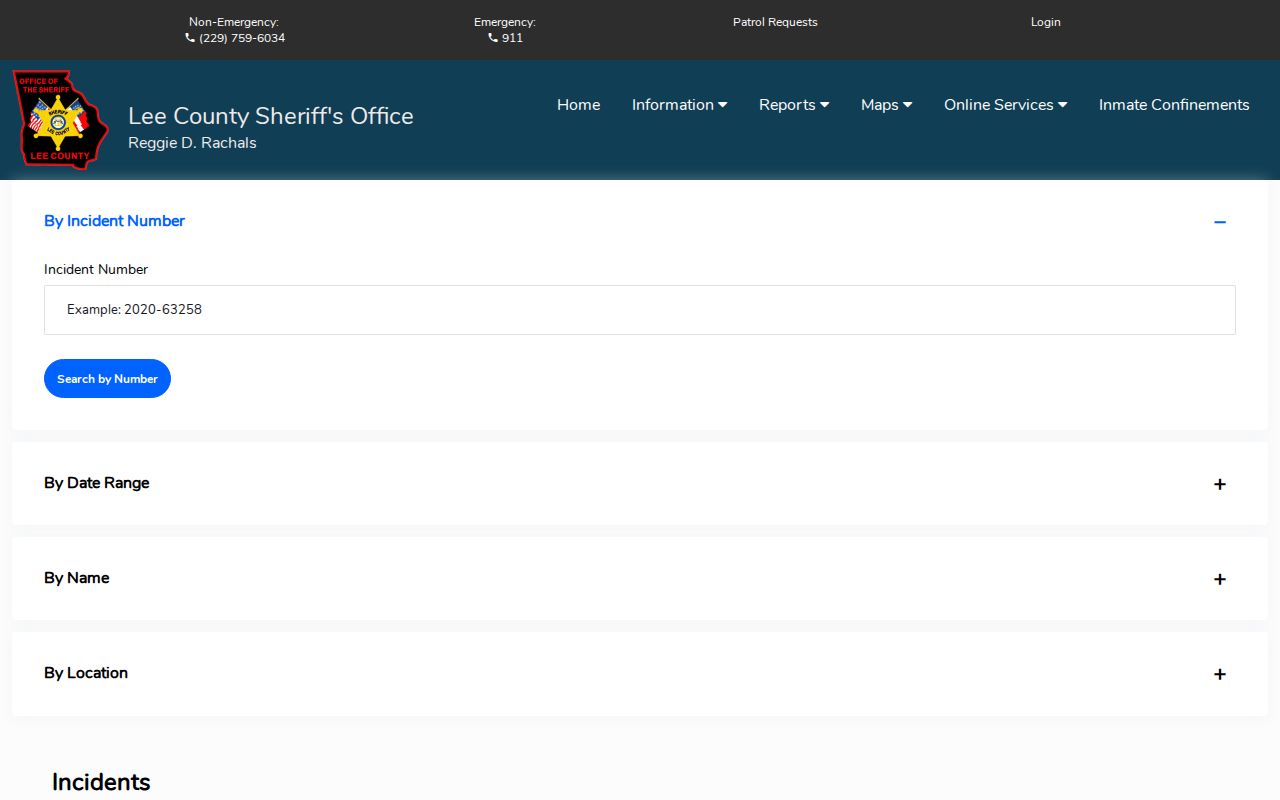
Incident numbers, dates, names, and locations describe reported incidents only. They do not confirm any current Lee County warrant.
NextRequest Handles Lee County Sheriff Records
Lee County handles sheriff records requests through its NextRequest portal. You file a written request there. The portal tracks status, carries the correspondence, and delivers whatever responsive documents come back. Ask for one defined record that exists. Useful details include the record type, the likely agency, a date range, and any case or citation number. Personal data stays out of public-facing text. That means no Social Security number, full birth date, address, or filled-out form holding private details. Lee County says a requester should be contacted within three business days with a production timeline. Fees, redaction, and exemptions can still apply. That window is not a promise of same-day warrant verification, and a written request cannot recall, quash, pay, or otherwise clear a warrant. Only the issuing court can act.
Records route: Use NextRequest for documents and the issuing clerk or sheriff for current status and procedure.
Lee County Warrant Status Words
Lee County courts share no common status dictionary. The same word can mean two things. Ask the issuing clerk what a term means in that court and when the status was last checked, because a label with no source timestamp can sit stale.
- Active
- The source reported the order outstanding at that time.
- Served
- Law enforcement executed the order; the court case may still require action.
- Recalled
- The issuing court withdrew its order.
- Quashed
- The court set the warrant aside through judicial action.
- Sealed
- The record is restricted from ordinary public view.
Do not read a missing web entry as a recall. Lee County has no official public warrant screen, so there is no list whose disappearance could ever prove an order was pulled.
Access and Restricted Warrants
The Georgia Open Records Act, O.C.G.A. §§50-18-70 et seq., opens public records in Lee County but keeps exemptions intact. Sealed material, juvenile records, protected personal data, and some active-investigation information can be withheld or redacted. An unserved warrant may stay unavailable too. So a blank result in any public source never proves that no order exists. Federal matters run a separate path. Start with the U.S. District Court for the Middle District of Georgia, Albany Division, and with federal law enforcement. PACER serves dockets, not a complete public federal-warrant index. Sealed or unserved federal warrants may not show up. Georgia Felon Search is a conviction-history product. It is no Lee County warrant lookup.
Key rules:
Use the Georgia Open Records Act for the public-record framework, while respecting exemptions and court seals.
Use the controlling court for status because a custodian’s document response does not change a judicial order.
Keep identifying data private and verify every contact through an official government or court page.