
Bench Warrants in Lee County
A bench warrant is a judge's order tied to a court obligation. The clearest Lee County example is a missed Leesburg Municipal Court date. The city's official FAQ tells a person who forgot a date to call the clerk at once and warns that ignoring the matter can lead to a bench warrant. It also notes a separate possible report to Georgia's Department of Driver Services in traffic cases.
Local sources do not support a universal list of every trigger, fee, or cure. A Superior Court criminal matter, county Magistrate matter, Leesburg citation, and Smithville city case can follow different paths. Read the actual court paper. The order's issuing court and case type determine the response.
A Missed Leesburg Court Date
The Leesburg Municipal Court FAQ gives Lee County's strongest published failure-to-appear directions. Call the clerk immediately at (229) 759-6465. Ask whether a bench warrant was issued, whether the court requires an appearance, and whether a DDS notice was sent. The clerk may explain procedure, dates, and payment routes but cannot give legal advice or recommend a plea.
The official FAQ is shown in the source capture below.
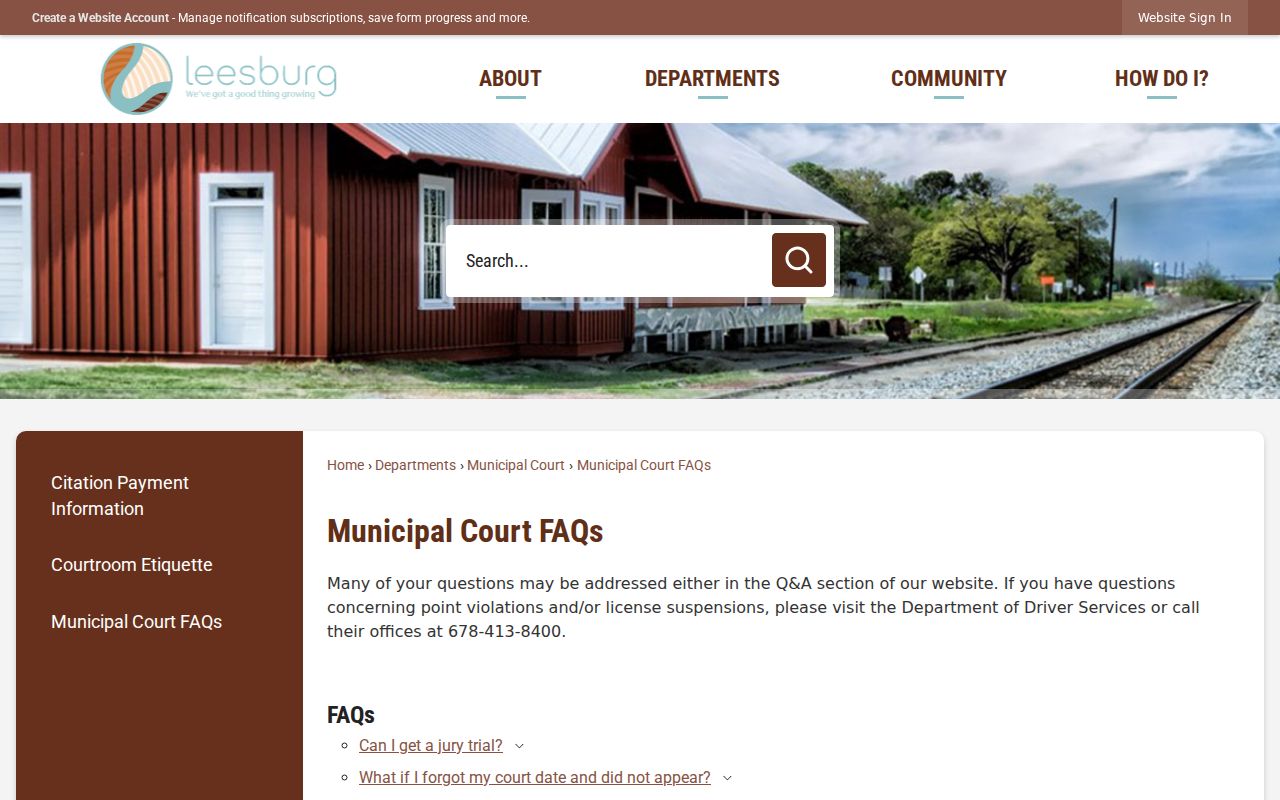
The page ties a forgotten date to a possible bench warrant and DDS action, which are related but separate consequences.
If a person cannot afford the fine, the FAQ directs that person to appear and address the judge. It does not promise a payment plan or automatic warrant recall.
How a Bench Warrant Is Issued
The judge, not the sheriff or clerk, issues a bench warrant. In the published Leesburg example, a person first has a court obligation, misses the date, and may then face a judge's bench warrant. Once issued, law enforcement can act on the order. A clerk can report the procedure but cannot reverse judicial action on personal request.
Georgia has no single public statewide warrant portal, and Lee County publishes no full bench-warrant table. An order can remain open until the court takes the action required by the case. That may involve appearance, a new setting, payment when permitted, bond, or a judge's recall. Do not assume that time alone ends the warrant or that a missing online result changes it.
Note: Lee County sources use “bench warrant” and “failure to appear,” not the Texas term “capias pro fine.”
Lee County Payment Is Not Instant Recall
Leesburg allows online payment for certain eligible citations through EZCourtPay, along with stated mail, drop-box, and in-person routes. Yet payment and warrant status are not the same event. The city's official payment page says a person with an active arrest warrant remains subject to arrest until the Municipal Judge accepts the payment and processes the case. Processing is usually the next business day, with weekends and holidays able to delay it.
Caution: A payment confirmation is not proof that a Lee County bench warrant has been recalled by the issuing judge.
The Leesburg citation-payment source states that key limit.
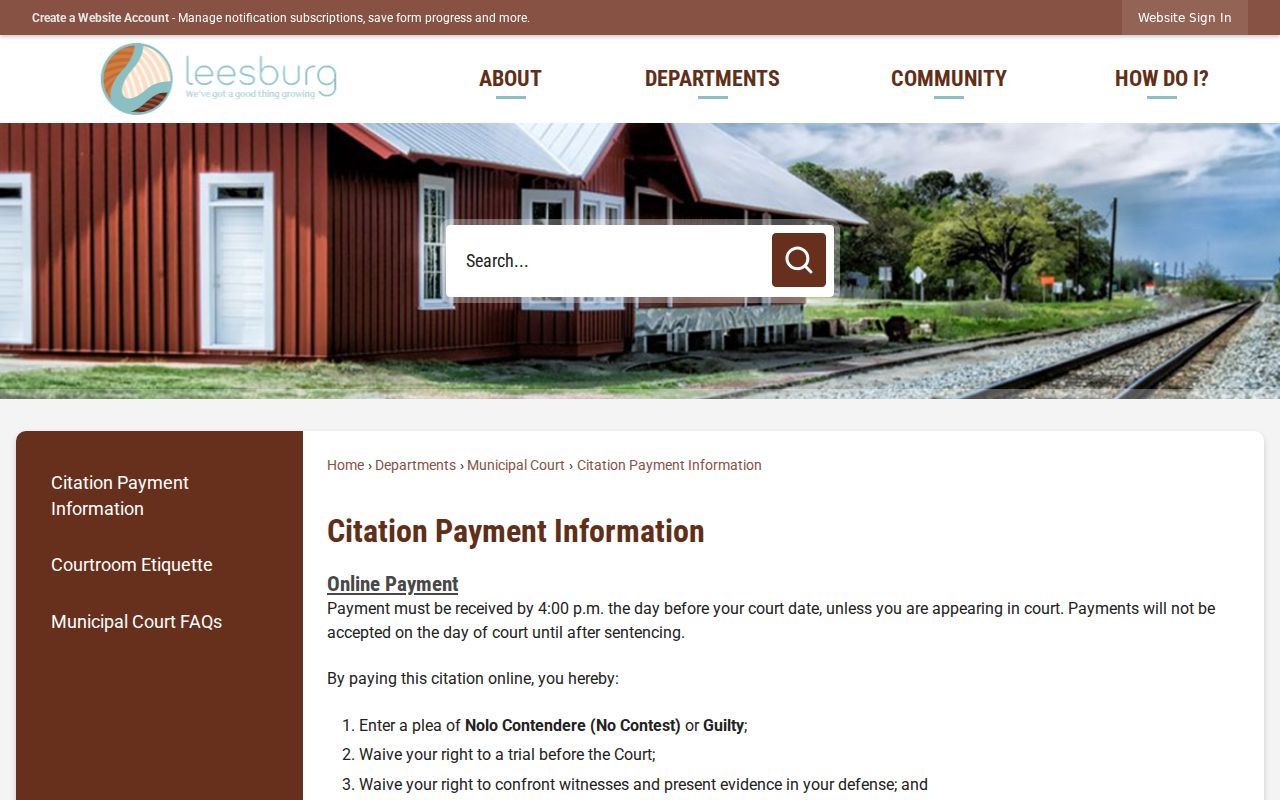
The capture helps separate a payment channel from a live judicial status check.
Lee County Bench Warrant vs Arrest Warrant
Both orders can authorize custody, but their starting points differ. A Lee County bench warrant commonly follows a missed duty in an existing case. An arrest warrant rests on probable-cause information presented for judicial review. Lee County Magistrate Court expressly lists arrest and search warrant issuance, while Leesburg's FAQ supplies the local missed-date bench-warrant example.
| Feature | Bench Warrant | Arrest Warrant |
|---|---|---|
| Starting event | Missed date or unmet court duty | Probable-cause submission |
| Judicial action | Judge issues from an existing court matter | Authorized judicial officer reviews an affidavit or application |
| Record owner | Court with the underlying case | Issuing court, with service records held by law enforcement |
| Next step | Ask that court about appearance or recall | Seek counsel about surrender, bond, and first appearance |
Bench Warrant and DDS Status
A traffic failure to appear may lead to two different tracks. The court can issue a bench warrant. It can also send a failure-to-appear notice to DDS, which can affect a license after the state notice process. Georgia DDS describes a 28-day interval after notice before suspension takes effect. The court issue and license issue must each be checked with the office that controls it.
- FTA
- Failure to appear or respond under the court's rule.
- Bench warrant
- A judicial order arising from the court matter, often after a missed date.
- DS-912 or DPS912
- The Georgia DDS failure-to-comply notice and release context, not a warrant-recall order.
- Recall or quash
- Court-specific terms for judicial action that changes the warrant.
Leesburg says a release must be taken to DDS and verified. Restoring a license does not itself prove that a Lee County bench warrant was recalled.
How to Resolve a Lee County Bench Warrant
No Lee County amnesty, walk-in recall docket, or countywide online clearance route was found. Resolution is case-specific and belongs to the issuing judge. A safe sequence limits wrong-office calls and helps a lawyer assess custody and bond risks.
- Confirm the issuing court from the citation, case notice, or an official phone check.
- Ask the clerk what procedure the judge requires and whether a warrant is active now.
- Consult a Georgia lawyer about recall, quash, appearance, surrender, and bond before going in person.
- Complete only the payment, new date, appearance, or other act the issuing court directs.
- Verify the court's final warrant status and handle any separate DDS release process.
Caution: Do not appear without confirming the process; Georgia guidance warns that a person with a warrant may be taken into custody.
Lee County Clerks Explain Procedure
A clerk is a vital route to the right docket, but not a source of personal legal strategy. Leesburg Municipal Court says its clerk cannot give legal advice or recommend a plea. That boundary applies to requests for a promise that payment will erase a warrant, a prediction of what a judge will do, or a recommendation about surrender.
Ask factual questions: Which court owns the case? Is a hearing set? What identification is required? Does the court show an active bench warrant? Is online payment eligible? Has the judge processed it? Was a DDS notice or release sent? Then take legal questions to counsel.
An Open Records request can seek an existing policy or record under the Georgia Open Records Act. It cannot schedule a hearing, change the status, or command a clerk to create a new warrant report.
Which Lee County Court Issued It
The issuing court owns the judicial response. For Leesburg traffic and ordinance matters, call Municipal Court at (229) 759-6465. Smithville confirms a municipal court but publishes no warrant procedure, so use its main city line, (229) 903-5537, to verify the current clerk route. Do not copy Leesburg rules onto a Smithville case.
Lee County Magistrate Court handles the warrant, bond, and preliminary functions stated on its official page and can be reached at (229) 759-6016 or (229) 759-6031. The Superior Court clerk says the office maintains criminal warrants and cases and uses (229) 759-6018. Probate Court collects county traffic fines but is not a universal criminal-warrant index.
The sheriff may route a status or service question through its non-emergency line, yet only the court can recall its order. Once identified, the Lee County warrant records home page gives the broader resolution framework.
Lee County Bench Warrant Records Requests
For a retained record rather than live status, direct the request to the custodian that holds it. The Superior Court page says its clerk maintains criminal warrants and cases. The Sheriff's NextRequest portal handles defined sheriff records. Municipal clerks keep city court material. A narrow request should name the court, record type, case or citation number if known, and a reasonable date range.
Georgia Open Records rules allow fees and redactions and do not open sealed or confidential matter. A request also does not pause enforcement. If the need is urgent, call the issuing court and obtain legal advice instead of waiting for a document response.
Note: A record copy shows what was retained at a point in time; only current court confirmation answers present warrant status.